

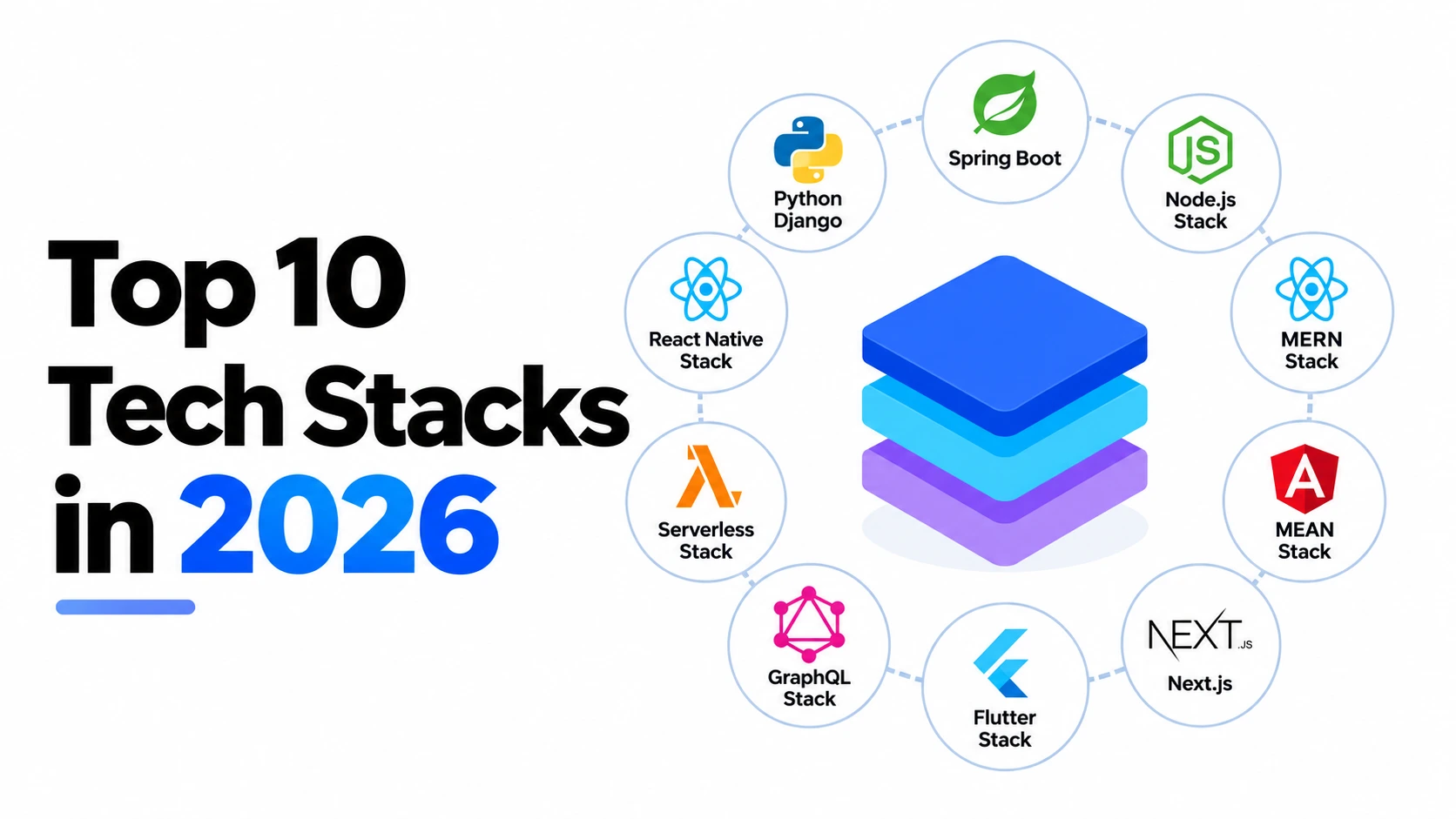
A company came to us fourteen months after picking its tech stack over one weekend, following a single conference talk. Hiring had stalled, the cloud bill had doubled, and a rewrite sat on a roadmap nobody had budgeted for. The tools were fine; they did not fit the team.
Across 150+ client engagements in 30+ industries, we see this pattern every quarter, usually within a year of launch. Stack Overflow's 2025 Developer Survey shows Python up seven points to 57.9%, with 84% of developers using or planning to use AI tools, so a modern tech stack must be AI-ready first. Below you get ten stacks, a comparison table, and a simple rule for choosing the right one before you commit.
What Is a Tech Stack?
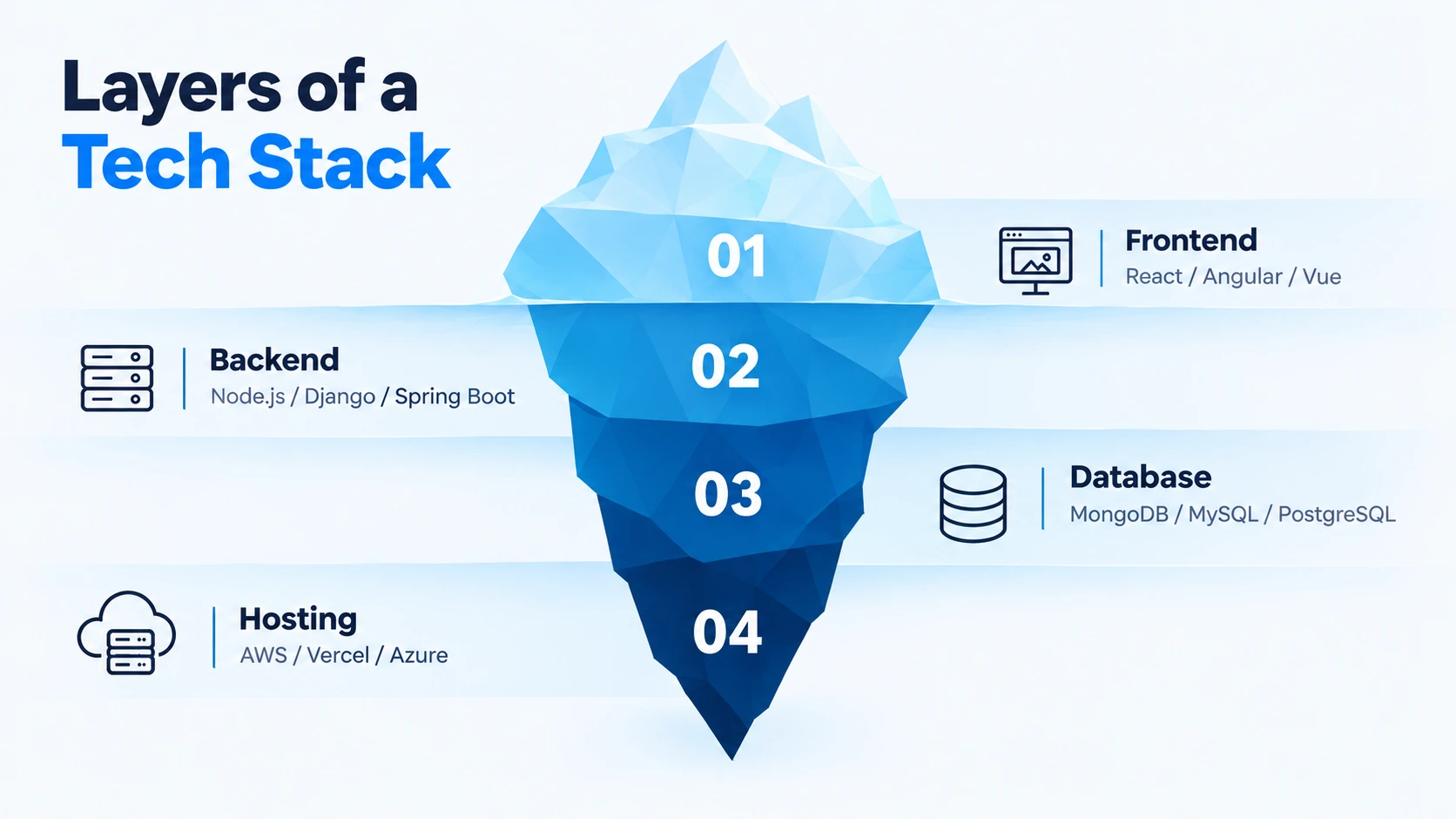
A tech stack is the set of languages, frameworks, databases, and infrastructure that build and run an application. Sort it into four layers:
- Frontend: What users see.
- Backend: Business logic.
- Database: Storage.
- Hosting: Where it runs.
No single best stack exists, only the best fit for one constraint. Imaginary Cloud and Gaper reach the same verdict; hiring depth, compliance, or launch date usually decides before the language does.
1. MERN Stack (MongoDB, Express.js, React, Node.js)
MERN runs JavaScript and JSON from the database to the browser, so one full-stack developer can own a feature end to end. As a custom web application development company, our web development team reviews this choice before the build starts.
- Strength: One language across every layer.
- Trade-off: MongoDB suits strict transactions poorly.
- Best for: SaaS, e-commerce, interactive social apps.
2. Python-Django Stack
Django is the batteries-included choice: ORM, authentication, and an admin panel arrive in the box. Python also owns the model tooling, so analytics sits beside the web app.
- Strength: Rapid builds, Python data tooling.
- Trade-off: Not the first pick for high-throughput real-time systems.
- Best for: ML apps, analytics dashboards, large CMS builds.
3. Flutter Full-Stack (Flutter + Firebase/Supabase)
One Dart codebase compiles to iOS, Android, web, and desktop, a strong route into cross-platform mobile development across platforms. Flutter draws its own interface, so screens look identical on every device. Firebase or Supabase adds authentication, database, and storage, which shortens time to market and keeps the user experience consistent.
- Strength: One codebase and a fast launch.
- Trade-off: Smaller Dart talent pool; React Native is the alternative.
- Best for: Consumer apps, design-led products.
4. Blockchain Stack (Ethereum/Solana + Web3.js/Rust)
The stack splits by network: Solidity on Ethereum, Rust on Solana, Web3.js on the client. Most products do not need it. The test: If no trusted party can hold the ledger, consider it; otherwise, skip.
- Strength: Trustless, tamper-evident records.
- Trade-off: Audits, niche hiring, gas costs.
- Best for: DeFi, tokenised assets, digital identity.
5. AI-Native Stack (Next.js + FastAPI + LangChain)
A Next.js interface sits over FastAPI serving Python models, with LangChain orchestrating LLM calls and retrieval. Artificial intelligence features need a vector store such as pgvector, Pinecone, or Weaviate, and reliable AI assistants depend on clear response workflows: Retrieve, call the model, check, reply. You do not migrate to an AI stack; you add an AI layer to the one you already run.
- Strength: Adds AI to almost any existing stack.
- Trade-off: Inference cost scales with usage.
- Best for: Copilots, RAG search, agent-driven products.
6. T3 Stack (Next.js + TypeScript + Tailwind + Prisma)
T3 gives type safety from database schema to UI. Change a column in Prisma and the compiler flags every screen it breaks, so integration bugs never reach the user experience. TypeScript here is not overhead; it is the cheapest documentation your team will write.
- Strength: Breaking changes caught at compile time.
- Trade-off: Assumes a JavaScript-fluent team; weak for heavy data processing.
- Best for: Modern SaaS, dashboards, web portals.
7. Java Spring Boot Stack
Banks and fintechs default to Spring Boot: Auto-configuration, a battle-tested JVM, and mature microservices support. Java has held a top-five place in the TIOBE Index, so hiring is rarely the problem.
- Strength: Proven and compliance-friendly at scale.
- Trade-off: Verbosity and a heavier memory footprint than Node.
- Best for: Regulated fintech, enterprise back offices.
8. Serverless Stack (Vercel + AWS Lambda + Supabase/DynamoDB)
Serverless runs event-driven functions and bills per call, so idle time costs nothing, which makes it a natural base for cloud-native application development. Vercel serves the frontend, AWS Lambda runs the logic, and Supabase or DynamoDB stores the data. See our cloud migration assessment for wider moves.
- Strength: Pay per use with automatic scaling.
- Trade-off: Cold-start latency and long-running jobs.
- Best for: Spiky traffic, event-driven backends, lean teams.
9. MEAN Stack (MongoDB, Express.js, Angular, Node.js)
MEAN swaps React for Angular, giving a structured frontend for large teams. On MERN vs MEAN, the split is flexibility against structure: React lets ten developers build ten ways, while Angular keeps a forty-person team consistent and limits technical debt.
- Strength: Enforced structure at scale.
- Trade-off: Steeper learning curve, fewer developers than React.
- Best for: Enterprise dashboards, secure portals.
10. LAMP / LEMP Stack (Linux, Apache/Nginx, MySQL, PHP)
LAMP and LEMP still power much of everyday web design & development, from WordPress to Laravel and Magento, at minimal hosting cost. It is unfashionable, and it works. PHP developers are plentiful, and one-command deploys suit small teams.
- Strength: Cheap hosting and a huge talent pool.
- Trade-off: Scaling means re-architecting; real-time features fit awkwardly.
- Best for: Content-heavy sites, classic e-commerce, rapid monolithic MVPs.
How to Choose the Right Tech Stack for Your Project
How to choose a tech stack comes down to one rule: The constraint that binds hardest picks the stack. Speed, hiring, compliance, throughput, and AI are the usual candidates. Name yours first, score each shortlisted stack against it, and treat everything else as preference rather than a deciding factor.
Match the Stack to Your Product Type
Web products point to MERN, T3, or Django, mobile to Flutter, Web3 to blockchain, and AI-heavy products to the AI-native stack. Content-led sites often suit LAMP, while regulated platforms lean towards Spring Boot. Match the product first, then argue about frameworks, because a stack that fights your product will cost you every sprint.
Factor in Your Team's Existing Skills
A stack you cannot hire for is a liability. Retraining a Java team onto Node costs months of reduced output, and a niche language narrows your candidate pool for years. Ask recruiters what they can source in 60 days, and check whether your engineers can ship a working feature in the new stack within a fortnight.
Plan for Scalability and Cloud-Native Growth
Serverless or Spring Boot beats a monolith when traffic is spiky, or compliance demands isolation; otherwise, a structured monolith is cheaper. What is cloud native? The cloud native meaning is simple: Small, independent services that scale on demand. Cloud native applications are earned, and cloud native security, such as least-privilege access and image scanning, needs planning from the first deployment.
Balance Budget and Time-to-Market
Lifetime cost beats sticker price. Hosting, maintenance, and hiring add up to total cost of ownership, and vendor lock-in raises it quietly. A cheaper stack may save a month at launch, yet the wrong one can cost a year in rework. Price three years, not launch week, and weigh how quickly each option gets you to market.
The Data Layer Behind Every Tech Stack
Every stack feeds a wider data ecosystem. Data engineers build data pipelines that move events into reports and models, and the data infrastructure underneath sets your running cost.
- Apache Kafka: Streams events in real time.
- Apache Spark: Processes large batches.
- ETL frameworks: Schedule and transform the flow.
- Cloud tools: Managed services from cloud providers host it.
- API interactions: Connect the services.
Plan this before adding AI, because model quality tracks data quality. A messy pipeline shows up later as confident, wrong answers.
How BuildNexTech Helps You Build on the Right Tech Stack
BuildNexTech helps teams choose the right tech stack, then build on it. As an AI development company, we connect AI to your existing stack through an API, so nothing needs rewriting. Teams get a low-code agent builder, observability, and production-ready deployment, so models stay monitored and easy to swap.
We start with your binding constraint, whether team skills, compliance, or launch date, and test each shortlisted stack against it before any build begins. Mobile follows the same test: as a mobile application development company, we choose mobile app development software that suits your team through our mobile app development services.
What a BuildNexTech Tech Stack Implementation Looks Like
- Day 1 to 3: Discovery, mapping where judgment calls break your flow.
- Day 4 to 7: Integration through APIs.
- Week 2 onward: First agent live on your highest-volume task, human reviewer in the loop.
- Ongoing: Monitoring decisions, cost per inference, and answer quality.
- At close: Your team owns the code and runbooks.
Conclusion
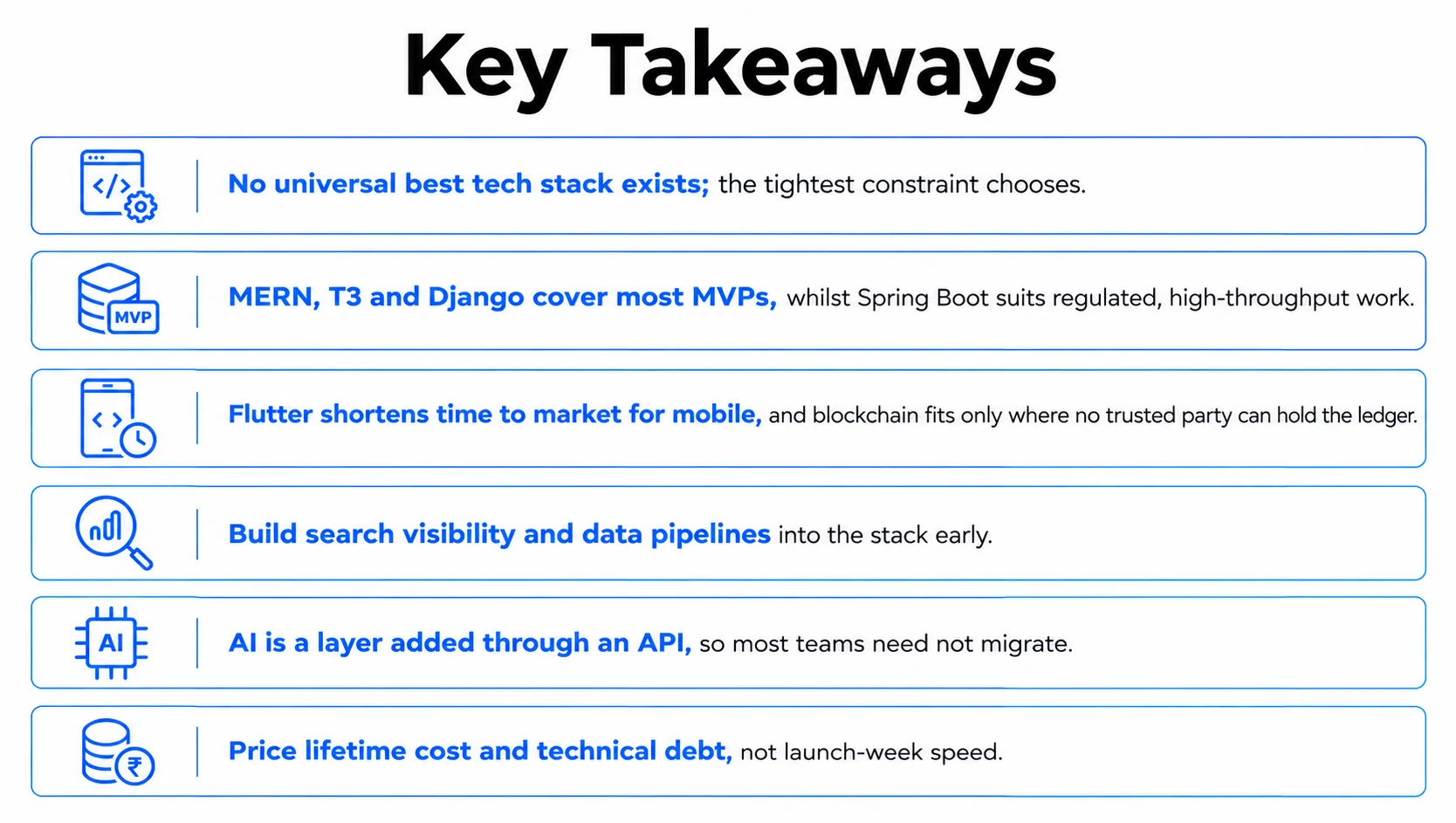
There is no winning tech stack in 2026, only the one that fits the constraint pinching hardest today. Speed points to MERN or Flutter, compliance to Spring Boot, data to Django, and AI to a layer rather than a rewrite.
Most rewrites begin as small compromises, such as a framework picked for launch speed. Review those choices against your binding constraint each year, while changing them is still cheap. Which of your current choices are quietly becoming next year's rewrite, and how would you know before the invoice arrives?
People Also Ask

How often should we review our tech stack?
Review it annually, and after major shifts in team size, traffic, or compliance needs. Track build times, incident rates, and delivery speed, and act when they worsen for two quarters.
How long does a tech stack migration take?
Small apps often move in weeks, while large platforms take months. Data volume, integrations, and test coverage set the pace more than the framework does.
How can we test a tech stack before committing?
Build a thin vertical slice, such as login, one core workflow, and deployment, within two weeks. Measure build speed, hiring response, and hosting cost first.
Does the tech stack affect application security?
Yes. Framework maturity, patch cadence, and dependency hygiene all shape risk. Choose actively maintained stacks, and automate dependency scanning and access controls from the first release.
Should we choose open-source or proprietary tools?
Open-source usually wins on cost, flexibility, and hiring pool. Choose proprietary tools only when vendor support, compliance certification, or a specific integration outweighs the lock-in risk.


.webp)
.webp)
.webp)

.webp)
.webp)