

.webp)
A logistics company came to us after a routine release took the checkout down for six minutes, and nobody on the call could agree on whose deployment strategy was actually to blame. It turned out nobody had chosen a deployment method that matched their risk tolerance to their infrastructure budget; they had just copied whatever a blog post called the safest deployment type. Choosing among deployment strategies is a fit exercise, touching every stage of the application lifecycle, from source code to production environment.
Across 150+ client engagements spanning 30+ industries, we have watched this decision get made backwards more often than not. This piece walks through the different deployment strategies teams run in software development, with a deployment strategy example for each, and shows how the same discipline now extends to something most guides ignore: Rolling out AI agents with the rigour applied to application code.
Types of Deployment Strategies Compared
A payments team we worked with ran one deployment strategy for every service across their software projects. It worked for two years, until a schema migration shipped with a bug and every instance updated at once, and the team spent ninety minutes rolling back manually while checkout sat down. Different deployment strategies exist because no single deployment method fits every deployment type. Here is how six of the most common approaches actually work:
Recreate Deployment (Big Bang)
This is the simplest approach: Shut down the old version completely, then bring up the new one in its place. It is often called an in-place deployment or big bang deployment, since everything changes at once with no fallback while the switch happens.
- Fast to set up, no duplicate infrastructure required.
- Guarantees downtime while the old version is offline.
- Best suited to internal tools or low-traffic services where a short outage is acceptable.
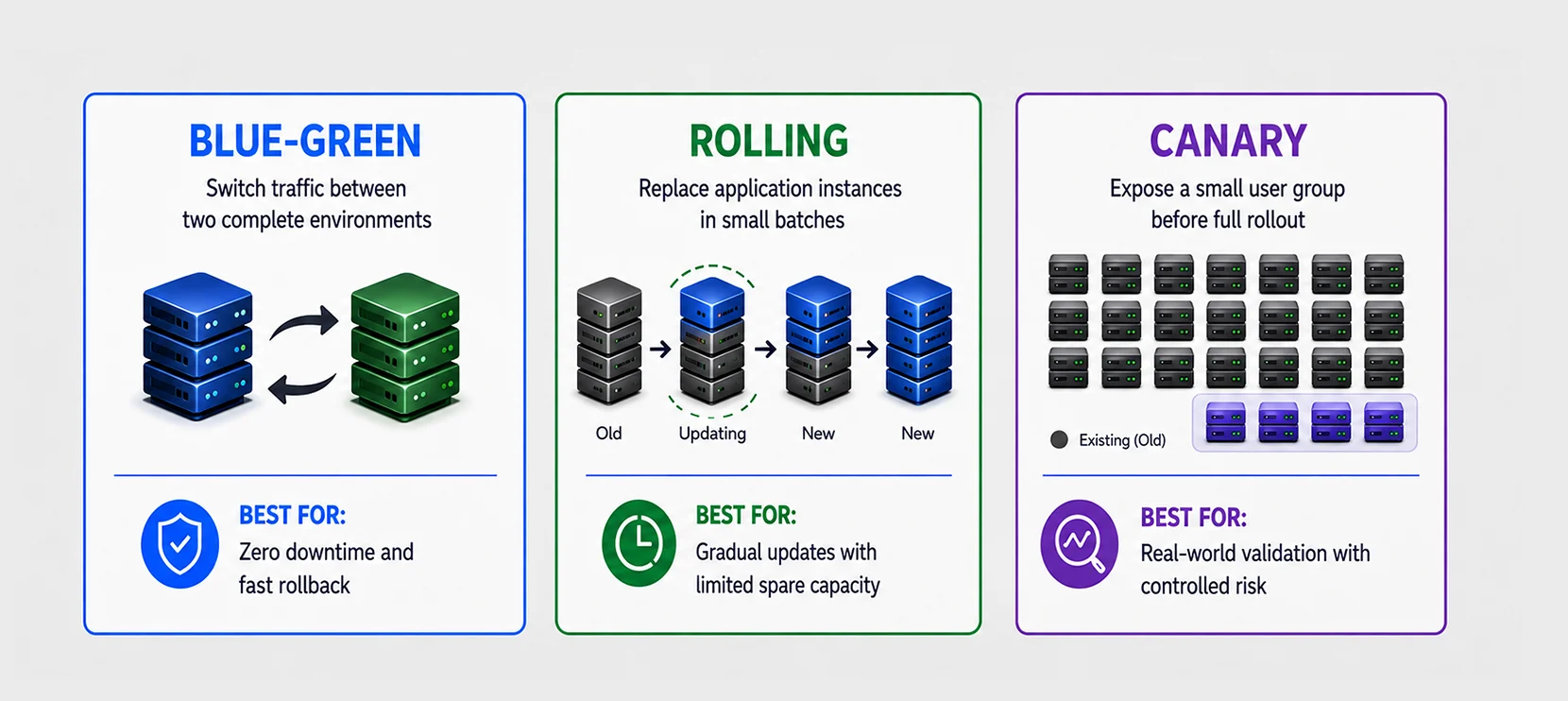
Rolling Deployment
Rolling deployment replaces instances gradually, a few at a time, while the rest keep serving traffic. It avoids full downtime but takes longer to complete than an instant cutover.
- Low infrastructure cost, since no second environment is needed.
- Rollback is slower, since old and new versions run side by side briefly.
- A common default for teams without a large infrastructure budget.
Blue-Green Deployment
What is blue-green deployment? It means running two identical environments, blue and green, and switching all traffic from one to the other instantly using load balancing, also called blue/green deployment.
- Rollback is near-instant: Just switch traffic back to the old environment.
- Requires paying for duplicate infrastructure, which raises cost.
- Well suited to regulated industries like payments, where downtime is expensive.
Canary Deployment
Canary deployment routes a small slice of live traffic to the new version first, then expands gradually as metrics confirm it is healthy.
- Needs traffic-splitting infrastructure and solid monitoring to work safely.
- Catches regressions before they reach every user.
- The right choice once a team already has the observability to support it.
Shadow Deployment
Shadow deployment mirrors live traffic to the new version without ever showing its responses to real users, so the team can watch how it behaves under real load.
- Zero risk to users, since nothing the shadow version returns is ever served.
- Requires more tooling to duplicate and compare traffic safely.
- Useful for validating a major rewrite before it goes anywhere near production.
A/B Testing Deployment
A/B testing deployment runs two versions at once, but the goal is comparing outcomes, like conversion rate, not just checking stability.
- Splits traffic deliberately to measure which version performs better.
- Needs analytics in place to make the comparison meaningful.
- Often used for product decisions as much as engineering ones.
Comparing All Six Strategies Side by Side
Reading through each strategy on its own is useful, but the decision usually comes down to a quick scan across all of them at once. The table below lines up downtime, rollback speed, infrastructure cost, and the main trade-off for each, so you can shortlist in under a minute.
Teams without traffic-splitting or automated rollback should not reach for canary deployment for its reputation alone; it adds a process layer nobody trusts when something breaks. Finding the right deployment strategy example starts with matching the table above to your downtime tolerance.
Blue-Green vs. Canary vs. Rolling
Most real decisions come down to these three. Blue-green wins when instant rollback matters more than cost. Canary wins when you need real-user validation and already have metrics infrastructure. Rolling wins when budget is the binding constraint. A logistics client runs blue-green for payments, canary for recommendations, rolling for everything else.
How to Choose a Deployment Strategy for Your Team
The obvious answer is to copy whichever strategy the biggest company in your space uses. That is almost always wrong, since their budget and compliance obligations are not yours.
Five factors decide this:
- Downtime tolerance: Know what an outage costs per minute in revenue and trust.
- Infrastructure budget: Confirm whether you can sustain a duplicate environment indefinitely or only briefly.
- Tooling maturity: Check if you already have traffic splitting and automated rollback in place.
- Architecture: Architectural practices differ for a monolith versus a microservices architecture.
- Compliance requirements: Some regulated industries mandate staged approval gates that limit which strategies are allowed.
Which one fits your team? More features do not make a pipeline safer than fewer, better-instrumented stages, so start with the simplest option that matches your constraints:
- Zero downtime tolerance, budget for duplicate infrastructure? Blue-green.
- Metrics infrastructure in place, want real-user validation first? Canary.
- Budget-constrained, moderate downtime tolerance acceptable? Rolling.
Cost is a fair objection. Size it against the incident it prevents: A team that loses ninety minutes of checkout availability has already spent more than a year of canary tooling would cost, all at once, in public.
Our Take: Most teams should start with rolling deployments and graduate to canary once they have the observability to use it, not before. Skipping straight to canary usually costs six to eight weeks of wasted setup.
Cloud Deployment Strategies for Distributed Systems
Managed Kubernetes, a container orchestration platform, changes the cloud deployment calculus: Cloud platforms like EKS and AKS make blue-green's duplicate infrastructure temporary.
- Canary deployment rollouts, defined in Kubernetes YAML files, route traffic before promotion.
- Cloud deployment models range from single-region setups to hybrid cloud deployment.
- Infrastructure as code, via Terraform providers, Terraform modules, and Terraform versions across Terraform Industries, keeps environments reproducible.
- Edge computing and a microservices architecture add regional complexity beyond a single cloud deployment.
Deployment Strategies in DevOps: Where CI/CD Fits
The ci/cd pipeline executes the deployment strategy: Continuous Integration merges source code, Continuous Delivery keeps builds releasable, and continuous deployment ships automatically.
- CI/CD tools like GitHub Actions, AWS CodePipeline, and Azure Pipelines run this CI/CD cycle end to end.
- Automated smoke tests, unit testing, and post-deployment validation catch what artifact repositories alone cannot.
- Internal developer platforms standardise these technical and DevOps practices as best practices across CI/CD pipelines.
- A tested rollback procedure protects the deployment process when a migration goes wrong.
Mobile Application Deployment Strategy
Mobile breaks one core assumption: There is no load balancer to flip. App store review removes instant rollback, so the mobile equivalent of canary deployment is a staged rollout, the Play Store's percentage rollout, or the App Store's phased release, slower than a Kubernetes canary step.
This differs from web application deployment, where a Node.js application's backend can flip traffic in seconds. Blue-green does not translate to mobile, since there is no traffic layer to switch on a device. Teams lean on feature flags inside the shipped binary instead. A fintech client built their release calendar around a seven-day review buffer.
Where Most Teams Get This Wrong
Most failures trace back to weak monitoring and security, not the deployment strategy itself.
- No monitoring setup or monitoring tools tracking error rate, system resource utilization, or site reliability via visualization tools.
- Missing runtime inspection of API behavior and API response behavior, plus weak API security and web application security.
- Docker container security, input validation, and secrets management often ship as afterthoughts.
- OAuth 2.0 and DDoS protection rarely get re-verified, undermining production-grade security.
How BuildNexTech Applies Deployment Strategy Discipline to AI Agent Rollouts
Every comparison guide on this topic stops at application code. None address what happens when AI systems themselves get rolled out as a model version or agent configuration, whether that is a generative AI development services engagement or a voice AI agent product.
Our agent orchestration layer supports canary, shadow, and rollback patterns for model and agent versions specifically, not just infrastructure. A team routes a defined percentage of live traffic to a new agent configuration, compares output quality and cost against baseline, and promotes or rolls back automatically on thresholds they set, cutting agent rollout incidents substantially by catching quality regressions in canary rather than after full rollout, echoing the logistics fleet's downtime reduction above.
What a BuildNexTech Agent Rollout Looks Like
- Configure the canary split and success thresholds: Quality score, cost, and latency.
- Monitor those thresholds against baseline in real time.
- Promote or roll back automatically once thresholds hold or fail.
- Walk away with a versioned, auditable record of what was deployed and why.
Who This Is For
This fits engineering teams running LLM or agent features with no canary stage and no rollback path for model swaps, or scaling from one agent workflow to several. If a bad model swap has already caused a production incident, that is the trigger.
%20(1).webp)
Conclusion
The right deployment strategy was never about finding the safest name on a comparison chart. It is a fit decision that shifts as your infrastructure, budget, and blast radius change, and most teams run two or three deployment strategies across their software deployment stack rather than standardising on one. The discipline that protects software applications - staged exposure, defined thresholds, automated rollback- is the same discipline that needs to protect AI agent rollouts, and most teams have built the first without the second.
People Also Ask

How often should a team revisit its deployment strategy choice?
There is no fixed schedule, but revisit whenever traffic, compliance requirements, or team size change meaningfully, typically alongside quarterly architecture reviews or right after any deployment-related production incident.
Is canary deployment more expensive than rolling deployment to run long-term?
Usually slightly, since canary needs traffic-splitting and monitoring tooling that rolling does not require, though the added observability often pays for itself the first time it catches a bad release early.
Which certification helps a team build infrastructure-as-code skills for deployments?
HashiCorp's Terraform Associate certification (Terraform certification) is the recognised entry point for AWS Terraform and Terraform AWS provider skills, covering Terraform modules, Terraform providers, and state management most cloud pipelines depend on.
Can a small startup run canary deployments without a dedicated platform team?
Yes, managed Kubernetes services and tools like Argo Rollouts handle the traffic-splitting logic, so a startup can run canary deployments with one or two engineers instead of a platform team.
Does deployment strategy choice affect how voice AI agents or generative AI features get released?
Yes, voice AI agents and generative AI features benefit from the same canary and shadow patterns covered here, since output quality, not just uptime, needs validation before release.


.webp)
.webp)
.webp)

.webp)
.webp)